When I went to locate some rules for the Mexican Train domino game, what immediately became apparent is that finding a gramatically correct set of rules is almost impossible. Lack of agreement between pronouns and their antecedents runs rampant, mostly unchecked, and unchallenged in the world today, and the extant literature on the topic of Mexican Train is no exception. Therefore, by the power invested in me as a curmudgeon of grammar, I assume the responsibility of providing such a web page for those, such as myself, who are irritated when reading web pages that persistently and consistently abuse the English language. It also gives me the power to be an authoritative arbiter of the rules of Mexican Train, if anyone wishes to appoint me, and it beats sitting around cursing the darkness of Internet.
These rules are intended as a guide. A group can actually use almost any set of mutually agreeable rules. In the end, the object is to have fun. However, whatever set of rules is chosen must be grammatically correct or the game is null and void.
The materials of the game consist of these items:
Each player creates a personal train using the dominoes he will draw. Optionally, a public or "charity" train that is always available to all players is created by assigning it a marker at the engine. The other trains start as private but become public if a player is unable to make a move and must draw from the boneyard. At that point, such a train is identified by placing the player's personal marker on it. A train becomes private again when a player is able to add to his own train, and the marker can be removed.
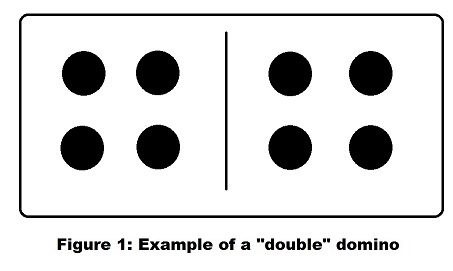
The object of the game is to reduce the numerical value of one's collection of dominoes to zero, or, barring that, to as low as possible. Each player assembles a train attached to the engine. The adjacent dominoes in the train must have matching values. A domino with equal values on each side is known as a double. Doubles are added to the train with the long edge adjacent to the short edge and must be immediately completed with a single of the same number.
The game is initialized by placing a double into the engine. The double can be selected in a number of ways. One way is to start wth a double-12 if anyone has it; that player goes first. If no one has a double-12, go down the list of doubles until one is located by a player and allow that player the first turn. The player who has the double may then select another domino to replace the double.
Play begins as each player selects a number of dominoes from the pool, also known as the boneyard, a term lifted from railroading, where it denotes a yard full of rail cars that have been removed from service, possibly to be used for spare parts. Use the handy table below to determine how many dominoes each player takes initially, or create your own table; apparently, the numbers listed below can vary. Prior to turn rotation, each player attempts to construct the longest possible train using the dominoes he has drawn. Ideally, players should place the remaining, unused dominoes on the table in such a way that they are not visible to the other players.
After the initial trains are constructed, each player takes a turn. He either places a domino onto one of the currently public trains or draws from the pool of free dominoes. If the latter option is necessary, the player places his marker in front of his train to indicate that his train is public if he has not already done so. If he can place a domino onto his own train, he can remove his marker, indicating that his train is now private. If he places a double onto a train, he must immediately add a corresponding single onto that train, either from his own collection or by drawing from the boneyard. Otherwise, each player must attempt to complete (answer, or justify) the double in the same way until it is completed. Players who have to draw must make their trains public if they have not already done so.
In one variant of the game, a player must announce "down to one" when he has one remaining domino, or else he is penalized by having to draw another domino and make his train public if it is not already public.
This continues until either a player has exhausted his supply of dominoes, in which case he is declared the winner of that round, or until no dominoes remain in the boneyard. In the latter case, each player is given one more turn, and then each player totals the values on his remaining dominoes. The player with the lowest score wins that round. A match can consist of multiple games, and the player with the lowest total across all the games wins the match.
Note: No so-called "artificial intelligence" was used to create this hand-crafted Internet web page. The author, a certified, real, live human being, has personally played Mexican Train with friends and relatives.
